If you thought that what's happening in today's newspapers has nothing to do with history, you're wrong. Just look at what's happening in the Korean peninsula.
In November 2010, North Korean artillery attacked an island controlled by South Korea, causing massive harm. Today, many newspapers are asking why North Korea attacked the South, as well as whether there will be another Korean War. For example, AOL News and Korean Times.
In order to answer these questions, one must understand Korea's past. After the end of World War Two in 1945, Korea was temporarily split into two halves (North and South). They were supposed to unite in a few years time. However, there were disagreements over how they should unite. In 1950, believing that these differences could not be settled, North Korea invaded the South in what was known as the Korean War.
Fighting stopped in 1953, but both Koreas have not made up and there are still a large number of disagreements.
To find out more about the Korean War, do read Wikipedia.
Friday, December 17, 2010

Hitler loses citizenship
After Hitler came to power in 1933, many towns and cities in Germany made him an "honorary citizen". That means that he was welcome to stay in the town, because of his contributions.
Surprisingly, he is still a honorary citizen of many towns. However, the Guardian reports that some have only just recently decided to remove him from the list.
Just one more of the lingering effects of history.
Surprisingly, he is still a honorary citizen of many towns. However, the Guardian reports that some have only just recently decided to remove him from the list.
Just one more of the lingering effects of history.
Thursday, June 17, 2010
Mein Kampf a hit on Dhaka streets
By Alastair Lawson BBC News, Dhaka (Bangladesh)
Booksellers touting their wares amid the heavy traffic in the Bangladeshi capital, Dhaka, have discovered an unusual best-seller.
Adolf Hitler's autobiography manifesto Mein Kampf is selling as well as Dan Brown's latest novel, The Lost Symbol.
The street vendors in Dhaka are found at every major road junction and intersection.
Most of the sellers are young boys and many compete with beggars to attract the attention of motorists.
Last week, Mein Kampf did unusually well because many bought the book to give it away as an Eid present...
Something to think about:
Hitler wrote his autobiography Mein Kampf in 1925 & 1926. The book sold very well. Hitler was able to buy a Mercedes when he was still in prison (according to Wikipedia).
Which of Hitler's ideas made him popular among Germans, and why? Why are Bangladeshis still finding him popular?
Thursday, February 4, 2010
Excavation in downtown Singapore yields wartime artefacts
Straits Times, 18 January 2010
NO ONE would bat an eyelid at demolition works in Singapore, so a torn-up carpark between City Hall and the old Supreme Court has probably drawn few curious gazes.
But it happens to be the site of a rare downtown archaeological dig, which has yielded precious secrets about the island’s past.
Click here for the full story.
NO ONE would bat an eyelid at demolition works in Singapore, so a torn-up carpark between City Hall and the old Supreme Court has probably drawn few curious gazes.
But it happens to be the site of a rare downtown archaeological dig, which has yielded precious secrets about the island’s past.
Click here for the full story.
Friday, January 1, 2010
Singapore History Sites
Check out the following history websites:
- The online portal Access To Archives Online (www.a2o.com.sg) and a World War II resource site (www.s1942.org.sg) house an online collection of archives, records and oral history interviews recounting memories of World War II and the Japanese Occupation in Singapore's history.
- the National Heritage Board's (NHB) blog (yesterday.sg),
- NHB's Education & Outreach division's website (www.mystory.sg),
- Singapore Collections Online (www.sgcool.sg).
- the social media portal, yesterday.sg, reaches out to fellow netizens to discover and share everything on heritage, history and culture, and promotes active contribution through blog posts, forum discussions and photo sharing. With over 2,000 blog posts to date, these address a range of topics, from old Singapore to food and hobbies of the past, and are checked for factual accuracy before being published.
- mystory.sg, gives an interactive and personal site which pieces together a personal side to Singapore history. These nuggets of history are narrated through stories, photos and videos.
- Singapore Collections Online (sgcool.sg), the first online repository of artefacts and artworks in Singapore, allows visitors from all over the world to view highlights from NHB's collections from the comfort of their own home. These collections include photographs, rare books, fabrics, ceramics, modern art forms and many other categories.
- The online portal Access To Archives Online (www.a2o.com.sg) and a World War II resource site (www.s1942.org.sg) house an online collection of archives, records and oral history interviews recounting memories of World War II and the Japanese Occupation in Singapore's history.
- the National Heritage Board's (NHB) blog (yesterday.sg),
- NHB's Education & Outreach division's website (www.mystory.sg),
- Singapore Collections Online (www.sgcool.sg).
- the social media portal, yesterday.sg, reaches out to fellow netizens to discover and share everything on heritage, history and culture, and promotes active contribution through blog posts, forum discussions and photo sharing. With over 2,000 blog posts to date, these address a range of topics, from old Singapore to food and hobbies of the past, and are checked for factual accuracy before being published.
- mystory.sg, gives an interactive and personal site which pieces together a personal side to Singapore history. These nuggets of history are narrated through stories, photos and videos.
- Singapore Collections Online (sgcool.sg), the first online repository of artefacts and artworks in Singapore, allows visitors from all over the world to view highlights from NHB's collections from the comfort of their own home. These collections include photographs, rare books, fabrics, ceramics, modern art forms and many other categories.
Thursday, December 17, 2009
Singapore History Tour
Singapore's city centre has an amazing amount of history sites to visit. Here's a suggested route (click to enlarge):
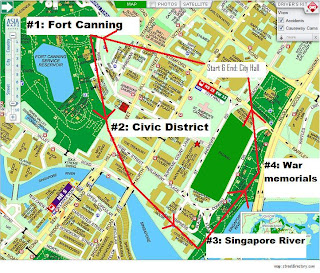
This tour should take around two hours at a comfortable walking pace.
Start: City Hall MRT
#1: Fort Canning
Before the 1500s, those who stayed in Singapore did not want to climb this hill as it was the site of palaces built by their ancestral kings. Indeed, archaeologist John Miskic has dug out artefacts that shown that a Malay kingdom could have been based on the hill.
Visit the Keramat Iskandar Shah at the foot of the hill. It is believed to be the resting place of Singapore's last Malay king (who ruled over 600 years ago).
Raffles also stayed on Fort Canning for a while. Check out Raffles terrace, the house where he lived in.
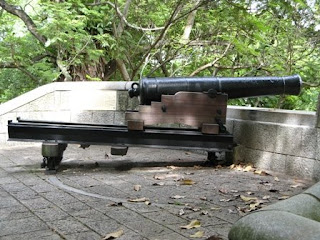
Fort Canning also has several cannons, built by the British to defend against attack. However, the cannons were never used for this purpose. They were only used to tell the time.
Also check out Battle Box, where British General Percival established his command post. The Japanese also used the fort for its military until 1945.
#2: Civic District
Visit:
- The Treasury: where Singapore's money is kept.
- The Supreme Court: Singapore's highest court.
- Parliament House: where Singapore's laws are made.
More importantly:
- City Hall. This was where the British accepted the Japanese surrender in 1945.
- Old Parliament House: the oldest existing government building in Singapore (built in 1827). It has a bronze elephant statue donated by the King of Thailand. The King of Thailand donated the statue to Singapore, as Singapore was the first foreign land to be visited by a Thai King.
#3: Singapore River
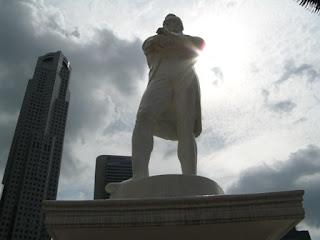
- Raffles' Landing Site: This is the spot where Raffles landed in Singapore on 28 January 1819. Look out for the white statue of Sir Thomas Stamford Raffles
- various sculptures: several local artists have placed sculptures, to show how life in early Singapore was like. Look out for these.
#4: War memorials
- Lim Bo Seng memorial: remembers an anti-Japanese freedom fighter
- Cenotaph: remembers those who fought in World War I and World War II
- War Memorial Park: remembers the civilians that died during World War II under Japanese rule. The memorial is also known as "four chopsticks" due to its shape.
End: City Hall MRT station.

This tour should take around two hours at a comfortable walking pace.
Start: City Hall MRT
#1: Fort Canning
Before the 1500s, those who stayed in Singapore did not want to climb this hill as it was the site of palaces built by their ancestral kings. Indeed, archaeologist John Miskic has dug out artefacts that shown that a Malay kingdom could have been based on the hill.
Visit the Keramat Iskandar Shah at the foot of the hill. It is believed to be the resting place of Singapore's last Malay king (who ruled over 600 years ago).
Raffles also stayed on Fort Canning for a while. Check out Raffles terrace, the house where he lived in.
Fort Canning also has several cannons, built by the British to defend against attack. However, the cannons were never used for this purpose. They were only used to tell the time.

Also check out Battle Box, where British General Percival established his command post. The Japanese also used the fort for its military until 1945.
#2: Civic District
Visit:
- The Treasury: where Singapore's money is kept.
- The Supreme Court: Singapore's highest court.
- Parliament House: where Singapore's laws are made.
More importantly:
- City Hall. This was where the British accepted the Japanese surrender in 1945.
- Old Parliament House: the oldest existing government building in Singapore (built in 1827). It has a bronze elephant statue donated by the King of Thailand. The King of Thailand donated the statue to Singapore, as Singapore was the first foreign land to be visited by a Thai King.
#3: Singapore River
- Raffles' Landing Site: This is the spot where Raffles landed in Singapore on 28 January 1819. Look out for the white statue of Sir Thomas Stamford Raffles

- various sculptures: several local artists have placed sculptures, to show how life in early Singapore was like. Look out for these.
#4: War memorials
- Lim Bo Seng memorial: remembers an anti-Japanese freedom fighter
- Cenotaph: remembers those who fought in World War I and World War II
- War Memorial Park: remembers the civilians that died during World War II under Japanese rule. The memorial is also known as "four chopsticks" due to its shape.
End: City Hall MRT station.
Sunday, October 25, 2009
A Broken World
Some Grade 9 (Sec 2, 14 year olds) students in Clay Burell's world history class at Korea International School created this multimedia wiki textbook covering world history from World War I to World War II and the beginnings of the Cold War. It was created in June 2007.
http://brokenworld.wikispaces.com/A+Broken+World
http://brokenworld.wikispaces.com/A+Broken+World
Subscribe to:
Posts (Atom)